
SolutionAI for public hospitals

AI Hospital Patient Care Assistant, from arrival to recovery at home.

An AI copilot for nurses and doctors in a busy public hospital. It checks every arrival for red flags, drafts the consultation note for the doctor to sign, and follows patients at home after discharge, so the few who are getting worse are found before they come back as an emergency.

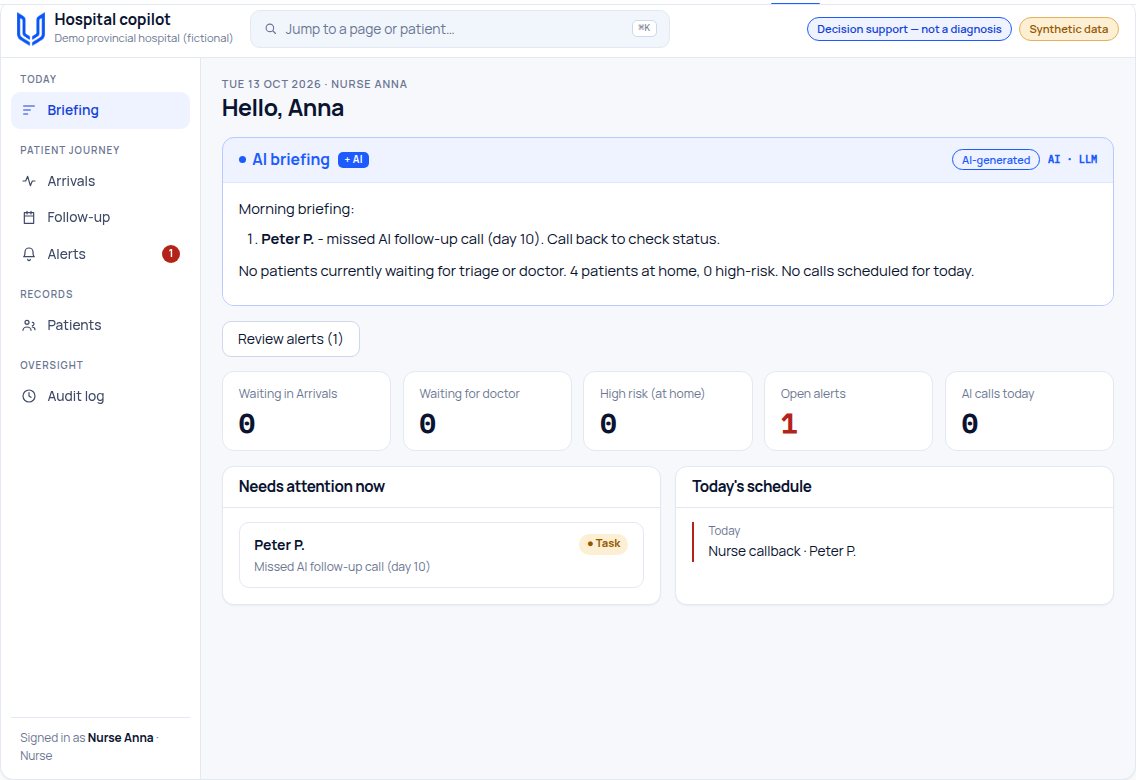
Hospital copilot console: a morning AI briefing, five counters for the ward and a list of what needs attention now

The nurse view of the hospital copilot. The patients are synthetic and the demo further down is the same console.

The context

Clinical work runs on seeing the right patient in time, and showing why.

Hospital teams work from vitals, notes, past visits and follow-up calls. The AI opportunity is to surface the patient who needs attention, draft the paperwork, and keep a clear record of who decided what.

Busy public hospitals

Public hospitals in Thailand and elsewhere care for more patients than their staff can follow. The gaps are at the front door, in the consult room and after the patient goes home.

Chronic conditions

Heart failure, COPD, diabetes and elderly patients go home and can deteriorate quietly. Many come back as emergencies.

Health data rules

Patient records are sensitive personal data. The Personal Data Protection Act B.E. 2562 (2019), where it applies, and each hospital's own rules shape who may see what.

Several roles

Nurses, doctors, patients and hospital directors each need their own view of the same record, and each action needs a name against it.

General background, not medical advice. Specific protocols, systems and volumes will come from the hospital during discovery.

What is the current issue?

Four steps, one shared problem: the patient who needs attention is not always the one who gets it.

The issues under each area are working hypotheses to test with clinical teams, not findings.

Arrivals

Every arrival checked against the same red-flag rules

  • Crowded outpatient departments: how urgent a case looks depends on who sees the patient first.
  • One nurse and many patients make a quiet red flag easy to miss.
  • Why a patient was ranked as urgent is rarely written down.

AI opportunity. The nurse types what the patient says and the vitals. Fixed red-flag rules set the level, AI writes the summary and the nurse confirms.

See the arrivals page

Consultation notes

AI drafts, the doctor decides

  • A large part of every visit goes to notes, codes and prescriptions instead of the patient.
  • Drug interactions, allergies and past visits are checked from memory under time pressure.
  • Notes are typed after the visit, so details are lost.

AI opportunity. Speech-to-text writes the conversation, AI reads past visits, drafts the note and suggests medicines. The doctor edits, resolves every flag and signs.

See the audit log of AI and human actions

Follow-up at home

Check-ins after discharge, set by the nurse, done by AI

  • Heart failure, COPD, diabetes and elderly patients go home and deteriorate quietly.
  • Follow-up calls compete with ward work, so the patient who most needs a call is not always the one who gets it.
  • Many patients come back as emergencies.

AI opportunity. AI suggests check-in days and writes questions for the patient's condition. The nurse edits and approves the plan and the patient answers in their own app.

See the follow-up page

Alerts and audit trail

The right person hears in time, with a record of who decided what

  • Warning signs reach the right person late, or not at all.
  • Missed calls and unanswered check-ins are not followed up consistently.
  • When something goes wrong it is hard to show which data a decision was based on.

AI opportunity. Fixed protocol rules read the answers and raise alerts, AI explains and drafts the action, and a nurse or doctor handles each alert or dismisses it with a reason. Every step is logged.

See the alerts page

How can AI help?

AI-driven workflows that end with a clinician's decision.

Each workflow starts from work nurses and doctors already do. Fixed rules and models do the checking, an AI agent drafts, and a named person decides.

From the front door to a confirmed level

The nurse starts from a ranked, explained list and confirms how urgent each arrival is.

  1. 1 Triage nurse

    Adds the arrival

    Types what the patient says and the vitals.

  2. 2 Fixed rules

    Applies red-flag rules

    Fixed rules set the level: Emergency, Urgent or Routine.

  3. 3 AI agent

    Writes the summary

    Summarises the note and says which rule fired and why.

  4. 4 Triage nurse

    Confirms the level

    Confirms it, or changes it with a reason.

  5. 5 Outcome

    Patient queued by urgency

    The doctor sees patients in order, with the reason on screen.

Tools the assistant calls

  • red_flag_rules(vitals)
  • summarise_note(arrival)
  • queue_patient(level)
  • log_decision(nurse)

Illustrative function names for a pilot design.

Today

Urgency depends on who sees the patient first, and the reason is rarely written down.

With AI

Every arrival is checked against the same rules, and the nurse confirms with the reason on screen.

The intelligence layer

One platform under all four steps.

The four steps share one record and one set of AI services, so each new use reuses what is already built. Data flows up, and rules, checks and the audit log wrap every step.

  1. Hospital data

    Records, vitals and visits stay in the hospital's own system

    • Patient records
    • Vitals and notes
    • Visit history
    • Medicines and allergies
  2. Rules and models

    Fixed protocols decide alerts, a model scores risk

    • Red-flag rules
    • Follow-up alert rules
    • Readmission risk model
    • Missed-call rules
  3. Intelligence

    AI reads the record and writes drafts, a person approves

    • Speech to text
    • Summaries and notes
    • Check-in questions
    • Briefings
    • AI copilot
  4. What people use

    One console for the care team

    • Briefing
    • Arrivals
    • Follow-up
    • Alerts
    • Patients
    • Audit log

What would the user see?

The hospital copilot.

This is the nurse view of the copilot: the morning briefing, arrivals, follow-up, alerts, patients and the audit log. Approve a follow-up plan, handle an alert and see every action recorded.

  • Read the AI briefing
  • Approve a follow-up plan
  • Mark the alert as handled
  • Filter the audit log
Hospital copilotDemo provincial hospital (fictional)
Jump to a page or patient…
Decision support — not a diagnosisSynthetic data

Tue 13 Oct 2026 · Nurse Anna

Hello, Anna

AI briefing+ AIAI-generatedAI · LLM

Counting today's work…4 steps

Waiting in Arrivals0
Waiting for doctor0
High risk (at home)0
Open alerts1
AI calls today0

Needs attention now

Today's schedule

TodayNurse callback · Peter P.
  • Triage and ward nurses

    Check new arrivals, approve follow-up plans and act on alerts and missed check-ins.

  • Doctors

    Run the consult with an AI scribe, sign prescriptions and review alerts.

  • Patients

    Ask about their own care in plain words and answer the care team's questions from home.

  • Hospital directors

    Watch readmission and workload, add staff accounts and read the audit log.

Key screens

One screen for each step of the patient journey.

Each tab opens the same console on one page and works on its own. All patients are synthetic and the answers are pre-written demonstrations, not medical advice.

Watch the briefing read the record, then open the alert it points to.

Hospital copilotDemo provincial hospital (fictional)
Jump to a page or patient…
Decision support — not a diagnosisSynthetic data

Tue 13 Oct 2026 · Nurse Anna

Hello, Anna

AI briefing+ AIAI-generatedAI · LLM

Counting today's work…4 steps

Waiting in Arrivals0
Waiting for doctor0
High risk (at home)0
Open alerts1
AI calls today0

Needs attention now

Today's schedule

TodayNurse callback · Peter P.

A morning briefing for the nurse: what needs attention now, in plain words, from the record and the open alerts.

What comes next?

From demo to pilot to production.

This page is the concept and working demo. Pilot scope, data, budget and timeline are agreed only after the hospital has seen it.

  1. Done

    Issue and problem

    The scope areas this solution covers.

  2. We are here

    Concept and working demo

    This page, with a working console on synthetic patients.

  3. Next

    Review and refine

    Adjust as more information arrives.

  4. Then

    Stakeholder walkthrough

    Validate the problem, data and needs.

  5. Then

    Pilot definition

    Scope, data, integrations, criteria, budget, timeline.

Demo

Now

Show the idea working, so stakeholders react to something concrete.

  • This page with working screens
  • Synthetic patients and pre-written answers
  • Walkthrough for the hospital team

Output: a stakeholder-ready demo.

Pilot

Next

One ward or clinic and an agreed set of real, approved records, alongside today's process.

  • Connect to the hospital record system
  • Language model for notes and questions, with a clinical review
  • Real sign-in, roles and a retained audit log
  • Success measures agreed before the start

Output: a scoped pilot with agreed measures.

Production

Later

More wards and clinics on the same platform, run and supported.

  • Connections to records, pharmacy and appointment systems
  • Hosting that meets health-data rules
  • Monitoring, support and model updates

Output: a supported service.

Measures to agree for the pilotRed flags missed at arrivalNote time per visit30-day readmissionsFollow-up check-ins answered

Built for clinical work

Trust and honesty about what this is.

A clinical team will ask where a flag came from and who decided what. The design answers that from the start.

This page is a demo

The console here replays pre-written answers on synthetic patients in a fictional hospital. A live system would read the hospital's own records.

Synthetic patients only

Every name, vital sign and score on this page is made up. The red-flag rules shown are for illustration, not a real triage protocol.

The AI drafts, people decide

Nothing is acted on until a nurse or doctor has read it, and each decision is recorded against a name.

Every step is logged

The audit log shows every AI, model, rule and human action: who, what, when and which model.

AI Hospital Patient Care Assistant. Next: a pilot definition.

Review the demo with your team.Tell us what a pilot must prove.

Decision support, not a diagnosis. All patients on this page are synthetic and the hospital is fictional. The red-flag rules shown are for illustration only; a real deployment uses the hospital's approved protocol. This page is not an official system of any hospital.